


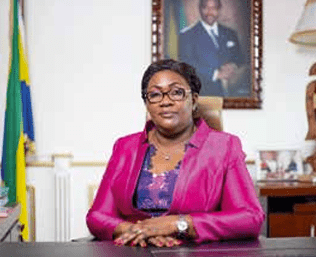
Interview with Nicole Jeanine Lydie Roboty, Mbou, Minister of Economy and Recovery since July 2020. A graduate of the University of Paris I and the Center for Financial, Economic, and Banking Studies (CEFEB), she previously served as Director of Negotiation and Monitoring of Mobilizations. She is the first woman to hold this position in Gabon.
Do you think that, following the economic crisis of the last two years, structural reforms in Gabon should be accelerated?
The pandemic has highlighted the structural weaknesses of our economy. These particularly concern: the very heavy dependence on revenues from extractive industries and imports of certain products, particularly food crops; the vulnerability of the fabric of small and medium-sized enterprises (SMEs) and very small enterprises (VSEs), already in difficulty due in particular to the narrowness of the market; the importance of public spending and the necessary corrections to be made to its trajectory, to land on sustainable public deficits; and the still high level of the economically fragile population, despite the efforts made in implementing the human investment strategy since 2015. Faced with this observation, the Government, following the guidance of the President of the Republic, Head of State, His Excellency Ali Bongo Ondimba, initially took measures
to mitigate the socioeconomic effects of the health crisis, then adopted in 2021 a recovery plan – Transformation Acceleration Plan (PAT) – structured around a vast program of structural reforms and structuring projects. It was this PAT that served as the basis for discussions with the IMF leading to the conclusion of a three-year program (2021-2022) under the Extended Credit Facility in July 2021.
What is the second generation program concluded with the IMF?
The second generation program supported by the agreement three-year (2021-2022) under the Extended Credit Facility (MEDC) that we concluded with the IMF is a set of structural reforms that the Government has committed to implementing over the three years in question. With regard to fiscal policy, the structural reforms adopted aim in particular to improve transparency in
the oil sector; rationalize tax and customs exemptions; implement environmental taxation; modernize and deploy revenue information systems; strengthen our institutional capacities in tax revenue; strengthen expenditure control, and improve the efficiency and effectiveness of public spending; ensure good management of available public resources; improve
cash management; strengthen our public investment management framework to improve execution and quality and address significant infrastructure gaps.
Regarding public debt and fiscal risk management, the Government's commitments pursue the objectives of strengthening debt management and ensuring better monitoring of the State's equity portfolio. Regarding social protection, the Government has committed to continuing to strengthen social protection by defining new eligibility criteria for economically weak Gabonese (GEF), conducting a survey, and establishing a new GEF database based on new poverty indicators. Financial sector reforms, meanwhile, will enable the liquidation of the three public banks to continue, establish the institutional framework for financial inclusion, and strengthen the financial sector.Finally, in the area of macroeconomic statistics, the agreed structural reforms aim to strengthen and modernize the national statistical system. I would like to conclude
on this question of the objectives of the three-year program to indicate that the said program is subject to half-yearly reviews.
How do you plan to attract innovative financing while promoting green growth?
Relaunching our economies has become a shared concern for all governments. However, implementing recovery strategies remains contingent on mobilizing significant financial resources commensurate with the challenges. This underscores the need to find innovative and appropriate financing.
At the same time, these recovery plans adopted by our countries must be an opportunity to accelerate the ecological transition process that is imposed on us. For our States, it is a matter of initiating a shift toward a new economic and social model that provides a comprehensive and lasting solution to the major environmental challenges of our century and the threats facing our planet. The ecological transition concerns several sectors. Among these sectors is the energy sector, which involves reducing traditional energy production and consumption and increasing the share of renewable energies in production and consumption. This is what we are trying to do in Gabon by encouraging the implementation of hydroelectric power generation projects. The other sector to be taken into account in the ecological transition is the industrial sector, an activity that emits significant amounts of greenhouse gases. It is a matter of rethinking these activities to reduce their carbon footprint and have the lowest possible ecological impact. This requires high-quality local production through a sustainable approach. Finally, we must encourage the agri-food transition, which will enable the development of environmentally friendly agriculture, thereby helping to strengthen the health resilience of populations. This also aims to reduce our food dependence on imports.
In reality, all these objectives are reflected in the PAT. Green finance is therefore a means of mobilizing the resources needed to implement these ambitions.
expressed by our highest authorities, headed by Mr. President of the Republic, who never misses an opportunity throughout the world to reaffirm his commitment to the preservation of the environment.
Many private investors are now integrating the concept of sustainable development into their projects. We must seize this favorable context to bring together the interests of private investors, the development ambitions of policymakers, and the achievement of the Sustainable Development Goals. Indeed, since the issuance of the first "green bonds" in 2008, green finance has grown considerably. It is part of sustainable finance, its ambition being to contribute to the development of a sustainable economy. In this regard, green finance relies on several instruments and mechanisms, such as green bonds or green or environmental funds. Ultimately, for Gabon, the "green" dimension of our economy and its financing is sufficiently integrated into national socioeconomic programs.
What can the AfCFTA bring to Gabon?
The African Continental Free Trade Area (AfCFTA) has four major objectives: the gradual elimination of customs tariffs and non-tariff barriers; improved cooperation in the area of technical barriers to trade and sanitary and phytosanitary measures; the development of value chains at the regional and continental levels; and the strengthening of development and industrialization in Africa. Given the many advantages offered by this economic area, the Gabonese authorities made our country one of the founding members of the AfCFTA trade agreement on March 21, 2018. Gabon subsequently deposited its instrument of ratification on July 7, 2019, in Niamey. This agreement thus becomes binding in all respects. While the AfCFTA has been operational since January 1, 2020, with the ratification of the treaty by 54 countries, negotiations on certain matters that must govern trade are ongoing.
That said, the AfCFTA, through trade in goods, could, among other things, offer our country: business opportunities; the opportunity to integrate into supply chains
regional values; the possibility of developing its agriculture; the opportunity to promote local products through our local SMEs; the opportunity to revisit our trade and cooperation agreements; the possibilities of being able to strengthen these infrastructures in terms of trade facilitation for greater competitiveness.
In relation to trade in services, the AfCFTA can offer Gabon the opportunity to become a Hub in terms of transit of goods in view of its geographical position and the market for exporting its services, in particular engineering,
cinematography, culture, audit, Ultimately, the AfCFTA is seen as an opportunity to accelerate the structural transformation of our economy to the extent that it induces in-depth adaptation reforms of our economic fabric to make it more competitive.