Advertising space purchasing interface

Drag
Your advertising space orders
Advertising rates
×

Loading...

Media Kit
×

Loading...

General Conditions of Sale
×

Loading...

Togo – Health, a priority sector

Position

Reference

Space not available

Reserve this advertising space

The file format is not recognized

Click here for
upload an ad

Click here to download
an announcement

Here drag and drop or
upload an ad

Send the ad up to 8 days after payment
A link will be sent to you by contact@via-agency.media

Reserved space
Announcement transmitted

If you want another location, you can move this ad

Reference

Togo – Health, a priority sector

medium-shot-doctor-holding-radiography

Since 2017, Togo has undertaken a reform of its health system in order to improve the financing of public hospitals and improve the quality of care.

Position

Reference

Space not available

Reserve this advertising space

The file format is not recognized

Click here for
upload an ad

Click here to download
an announcement

Here drag and drop or
upload an ad

Send the ad up to 8 days after payment
A link will be sent to you by contact@via-agency.media

Reserved space
Announcement transmitted

If you want another location, you can move this ad

Reference

In 2017, the government launched a contracting system in five public health facilities to improve the financial management of hospitals. Hospitals are now no longer managed solely by the state, but by private stakeholders working together on the basis of a public-private partnership.

To ensure quality care for the population, contracting has reached cruising speed, supported by initial eloquent results. The health facility remains public, and the state continues to pay its staff and equipment. A non-state entity is recruited with the specifications of implementing mechanisms for good management. A committee is established within the health facility. It includes the contractor, the training management, unions, representatives of the trades, and the various stakeholders involved. The actions and expenditures to be carried out are decided by this committee. The Ministry of Health and Public Hygiene, which remains the central level, ensures the regularity and relevance of actions and expenditures. 

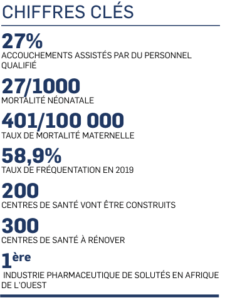
In addition to the actions already implemented or planned as part of the response to Covid-19, the government has committed to initiating numerous projects. On the infrastructure front, projects to modernize Regional Hospital Centers (CHR) are planned, as are the rehabilitation of Community Health Centers (CSC), the construction of six new Mother and Child Health Centers (CSME), 100 Medico-Social Centers (CMS), and a National Cancer Control Center (CNLC). Regarding the rehabilitation and equipment of hospitals, university hospitals and CHRs will be equipped with scanners, through group purchases.

Position

Reference

Space not available

Reserve this advertising space

The file format is not recognized

Click here for
upload an ad

Click here to download
an announcement

Here drag and drop or
upload an ad

Send the ad up to 8 days after payment
A link will be sent to you by contact@via-agency.media

Reserved space
Announcement transmitted

If you want another location, you can move this ad

Reference

In 2010, Togo joined the International Health Partnership (IHP+, now UHC2030), which provided health sector stakeholders with new resources for their work in strengthening the capacity of the health system. The Ministry of Health implemented a National Health Policy, and a widespread and participatory situation analysis led to the development of a National Health Plan (NHP).

Regarding family planning, the Togolese authorities have adhered to the FP 2030 commitments. The six commitments made by the government revolve around increasing the modern contraceptive prevalence rate among women in union from 23.1% in 2020 to 32% in 2026 and among all women from 20.4% in 2020 to 29.5% in 2026. The second commitment concerns the increase in the state subsidy from 50% in 2022 and from 25% from 2023 to 2026. The third concerns ensuring access for adolescents and young people to comprehensive information and quality services adapted to their age and needs. The fourth concerns the continued availability of contraceptive products at service delivery points in accordance with policies, standards and protocols. The fifth is intersectoral coordination of planning interventions and the use of evidence. Finally, the sixth commitment involves the mobilization of financial resources by Togolese civil society involved in health, reproduction, and family planning.

In November 2021, the World Bank launched a 70 million $ project to improve the quality of health and provide universal health insurance to 60% of the Togolese population. 

President Faure Gnassingbé, who has placed his new mandate under the seal of preserving and consolidating achievements, intends to significantly improve the health system and ensure quality health for the Togolese people, particularly for vulnerable groups. 

In the area of social protection, an amount of 91.7 billion CFA francs has been allocated to the health sector, or 7% of the amount allocated to ministries and institutions, for the 2022 financial year. This amount will be used to guarantee universal health coverage and access to health services for all. 

Position

Reference

Space not available

Reserve this advertising space

The file format is not recognized

Click here for
upload an ad

Click here to download
an announcement

Here drag and drop or
upload an ad

Send the ad up to 8 days after payment
A link will be sent to you by contact@via-agency.media

Reserved space
Announcement transmitted

If you want another location, you can move this ad

Reference

Togo, first African country to end sleeping sickness 

In 2020, Togo received validation from the World Health Organization (WHO) for having eliminated human African trypanosomiasis or "sleeping sickness" as a public health problem, becoming the first country in Africa to achieve this milestone.

Sleeping sickness is caused by parasites transmitted by infected tsetse flies and is found in only 36 countries in sub-Saharan Africa. If left untreated, sleeping sickness is almost always fatal. In 1995, approximately 25,000 cases were detected, approximately 300,000 cases were estimated to have gone undetected, and 60 million people were considered at risk of infection. In 2019, fewer than 1,000 cases were discovered. Togo has not reported any cases in the past ten years.

Togo's achievement comes after more than two decades of sustained political commitment, surveillance, and case detection. Beginning in 2000, the country's public health officials implemented control measures. In 2011, the country established surveillance sites in hospitals in the towns of Mango and Tchamba, which cover the main risk areas for the disease. Since then, public health officials have maintained increased disease surveillance in endemic and at-risk areas. 

A global collaboration led by WHO supported these efforts by facilitating the donation of medicines and resources by pharmaceutical companies, which helped build local capacity and ensure the continued availability of the tools needed to fight the disease. 

Position

Reference

Space not available

Reserve this advertising space

The file format is not recognized

Click here for
upload an ad

Click here to download
an announcement

Here drag and drop or
upload an ad

Send the ad up to 8 days after payment
A link will be sent to you by contact@via-agency.media

Reserved space
Announcement transmitted

If you want another location, you can move this ad

Reference